Sunday, April 19, 2020

3 Things Executives Need to Know Now About Communicating in Uncertain Times


Communicating in Uncertain Times
>

You already know this is not a moment to sit back. As a business executive leading through challenging circumstances, you understand that showing up and being present is more important than ever.

Your employees, your customers, your shareholders, and the broader community of stakeholders in your organization expect to hear how you are keeping people safe during the pandemic, how you’re providing continuity in a stricken economy, and how you are making sure your business is as strong as possible when the time to rebuild inevitably arrives.

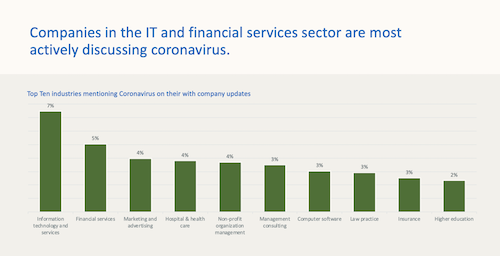
There’s an expectation you will address the pandemic and its impact on your organization. All industries have experienced an increase in discussing coronavirus, according to internal LinkedIn data. As the chart below shows, the IT and financial services industries are most actively discussing coronavirus and its impact.


While no one knows what the coming weeks and months will bring, one thing is certain: now is the time for business executives to lead by example, to communicate with purpose, and, to strive, as far as current business conditions allow, to deliver on the promises they made during better days.

Here are three things to keep in mind as you communicate with your stakeholders in a time of uncertainty.

>Our new executive guide, "Trust in a Time of Uncertainty," provides a deep view of how to build communications during this time. Download it now.

1. You Don’t Have to Have All the Answers

Your stakeholders are anxious. They are worried about the safety of their friends and family, they are worried about their own safety, they are worried about the impacts of the pandemic on their finances, and they are worried about how long it will be before something resembling normalcy is restored. Chances are you share the same concerns.

To establish trust in a time of uncertainty you don’t have to have all the answers, nor do you have to be free of doubt yourself. What you do have to do is communicate frequently, clearly, and authentically. That means avoiding jargon and platitudes. It means rejecting a temptation to offer assurances that aren’t yours to give.

It means explaining what you are doing and why you are doing it in simple language and always asking one important question: “What is the purpose of this message?”

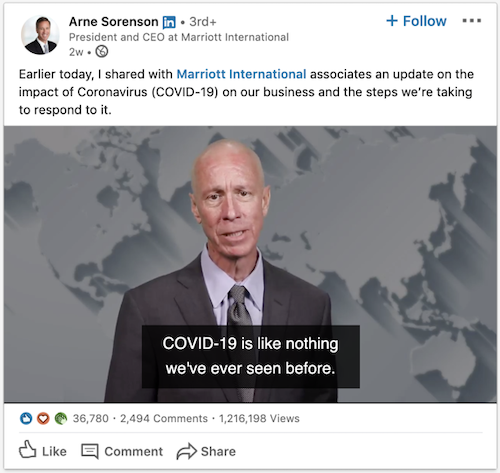
Arne Sorenson, the CEO of Marriott, offers a master class of concise and compassionate communication


2. Communicate Your Purpose

Your brand’s purpose will be put to the test by the pandemic and the attending economic, societal, and political fallout. Now is the time to prove that your brand’s purpose means something.

You can help ensure this by making sure your communications during this time are intentional and convey the concrete ways your business is putting actions behind its words.

These can be offers of assistance, gestures of gratitude, straightforward bulletins about changes designed to make your workforce safer or partnerships with organizations on the front lines of the battle against the pandemic. Rob Norman, senior advisor to GroupM, the world’s largest media agency, puts it this way:

“If we fight to only minimize investor losses, the consequential loss in other parts of the business and eventually to the underlying assets, will be catastrophic.”

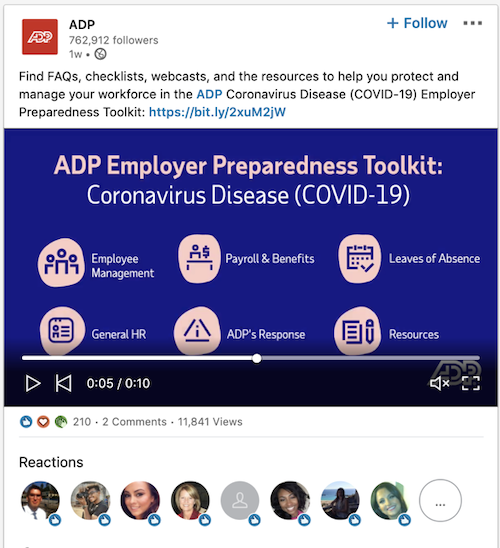
ADP, a global provider of human resources and payroll solutions, highlighted its commitment to advancing employee potential by launching a webcast series to help companies protect their workforce and understand government policies.


3. Build Tomorrow’s Leaders Today

This crisis will pass. Business leaders should use this time to invest in the talent who will be there for the brand when rebuilding is job number one. It’s important to strategically and thoughtfully elevate internal voices now who can share the work of communicating during this time of uncertainty.

Encouraging your workforce to develop skills on platforms such as LinkedIn Learning, which offers more than 15,000 courses with dozens more added weekly, underscores your commitment to your employees in the face of uncertainty.

Building up new talent and skills serves to not only open the aperture for a more diverse collection of voices and experiences representing your brand during the pandemic, but it also allows for team members to nurture and build leadership skills that will be essential when the time comes to shift focus from navigating daily uncertainties to charting a clear course forward in a time of rebuilding.

To be sure, business leaders are confronting extraordinary challenges and shepherding their organizations through an unsettled landscape that changes daily, but they also have a rich opportunity to show what executive leadership and brand purpose really mean when they:

>Commit to communicating authenticallyLive their brand purposeInvest in people and relationships

Communicating to your stakeholders during uncertain times is not easy. While we will all confront different challenges unique to our organizations, one truth is constant: We are #inittogether. Let us know how we can be there for you.

To gain more insights about how to drive valuable communication during this time, download the full version of the Trust in a Time of Uncertainty Executive Guide

Additional information can also be found within this resource hub

>


By: Karin Levi
Title: 3 Things Executives Need to Know Now About Communicating in Uncertain Times
Sourced From: business.linkedin.com/marketing-solutions/blog/linkedin-news/2020/3-things-executives-need-to-know-now-about-communicating-in-unce
Published Date: Wed, 08 Apr 2020 05:00:00 -0700


For More Information about our services please visit:

Fuseology Creative SEO Marketing Agency
1509 NE 83rd CT
Vancouver, WA 98664
360-602-2655

Additional Informational Links:


Fuseology Creative, by fuseology

Saturday, April 18, 2020

Going from Physical to Digital: 5 Virtual Marketing Events You Don’t Want to Miss


Top 5 Virtual Events for Marketers
>

With the current state of affairs, marketing conferences are being canceled to protect the safety and well-being of planners and attendees. But months of preparation don’t necessarily have to go out the window. In fact there are great examples of organizations that have quicklypivoted to digital and are hosting their events online for free.

Click here to see our previous coverage of how organizations are producing digital events using LinkedIn Events.

While you may not to get to experience these marketing events in-person, the content remains as valuable as ever. Below are five of the marketing industry’s most intriguing in-person events turned digital:

1. Discover MarTech: A Virtual Event for Strategies & Solutions – April 21-23, 2020

Technology has radically changed the landscape of marketing. Discover MarTech aims to provide marketers free training and thought leadership on a variety of topics, including how to build a state-of-the-art martech stack and how careers in marketing ops are changing.

Agenda details are yet to be fully announced, but you can expect in-depth training sessions from many of the marketing solutions providers that were set to speak at the original San Jose event.

2. AMA’s Virtual Conference: Experience Design– April 21-22, 2020

Hosted by American Marketing Association, this conference focuses on leveraging experience design to build your brand and rapport with your customers. Speakers will cover not only how to conduct better customer research, but how to improve collaboration between marketing and customer experience as well.

American Marketing Association CEO Russ Klein will kick off the event with a controversial topic – why you should end your addiction to storytelling. Each day will include two sessions as well as a closing keynote focusing on customer experience as a competitive distinction.

3. Content Marketing Conference– April 21, 2020

This year, Content Marketing Conference is opening its archive – four keynotes, 10 live workshops, and more than 150 on-demand sessions collected from past years. The agenda is stacked with interesting topics, ranging from building a message architecture to filming more authentic videos right on your smartphone.

4. C3 2020 Virtual Keynote – May 12, 2020

Swapping scale for intimacy, martech company Conductor is hosting its annual event in the form of a virtual keynote. Founder and CEO Seth Besmertnik will describe Conductor’s vision for the future of search and content marketing. Other leaders will dive into product innovations and SEO best practices, all with the intent of equipping marketers with the tools they need to maintain steady traffic.

If you know any organic marketing rockstars, consider nominating them for the Searchie Awards 2020! Winners will be announced to close out the event.

5. Midwest Digital Marketing Conference – May 20-21, 2020

Midwest Digital Marketing Conference has been hosted by University of Missouri-St. Louis since 2013. Now the largest digital marketing conference in the Midwest, MDMC has shifted to an online production split into two parts: a live two-day virtual summit and an on-demand digital experience.

You’ll have to pay extra for the digital experience in order to access the sessions that were supposed to take place in-person, but the live summit is absolutely free and will feature five breakout sessions led by the conference’s most in-demand speakers.

Even with our business travel limited right now, marketers still crave continuing education and may need it now more than ever. Marketers should know that the expert advice they want is increasingly available virtually.

Learn more about producing virtual events on LinkedIn by downloading our guide, Virtual Events on LinkedIn: The Activation Playbook


>


By: Caroline Young
Title: Going from Physical to Digital: 5 Virtual Marketing Events You Don’t Want to Miss
Sourced From: business.linkedin.com/marketing-solutions/blog/b2b-content-marketing/2020/going-from-physical-to-digital--5-virtual-marketing-events-you-d
Published Date: Thu, 09 Apr 2020 05:00:00 -0700


For More Information about our services please visit:

Fuseology Creative SEO Marketing Agency
1509 NE 83rd CT
Vancouver, WA 98664
360-602-2655

Additional Informational Links:


Fuseology Creative, by fuseology

Marketing Book Worth a Look: Content Chemistry by Andy Crestodina


Content Chemistry Andy Crestodina
>

Editor's Note: In a time when using content to send just the right message to your audience is as important as ever, Andy Crestodina's Content Chemistry remains a powerful guide for content marketers. We hope you find this encore post useful. 

For over a decade, Andy Crestodina has been the Strategic Director at Orbit Media Studios, Inc. He is a renowned content marketing expert, a sought-after public speaker, and has been recognized by Forbes and Inc. magazines as a thought leader in the profession.

In the lead-up to publishing his first book, Andy followed his own content marketing advice. “The idea was to ‘blog into a book’ by starting with structure, then making all my content work together,” he told us. The resulting book is a masterful meta-marketing tome; it’s both a stellar example of content marketing and a how-to guide for creating your own.

This Month’s Recommended Reading: Content Chemistry: An Illustrated Handbook for Content Marketing

Content Chemistry is the antidote to dry, black-and-white business books. Andy knows visual content captures readers’ attention and can easily convey complex information. So he doesn’t skimp on beautiful, informative charts and diagrams throughout. The result is a quick read packed with solid content marketing theory and tactical advice.

Why Andy Wrote Content Chemistry

Andy’s motivation for writing the book was to use his expertise to call marketers to action: “My hope is that your new insights into web marketing will motivate you to get started and stay active,” Andy says on the Content Chemistry web page. “I hope you realize that web marketing is enjoyable because it’s creative, something both social and analytical…You may discover that, yes, web marketing is critical to modern business, but it’s also a lot of fun.”

Why You Should Read It

Andy explains the basics of content marketing in an approachable, straightforward way. Content Chemistry covers all the key aspects of content creation and promotion, from SEO to social media to email marketing. “By the time you finish reading Content Chemistry, you’ll have a solid understanding of all the main topics and the specific actions you’ll need to take to succeed on your own. You’ll know where you’re going and how to get there,” Andy says.

The structure of the book, and Andy’s “blog into book” methodology, serve as a blueprint for your own content marketing strategy. “If you want to make your content work harder, give it structure,” Andy told us. “Plan the repurposing from the outset. The book is just the largest collection of your lifetime body of work. Blog within a larger framework, then combine, fill in the blanks, and polish.”

Read Content Chemistry to Learn How to:

>Attract visitors to your websiteConvert traffic into leads and customersMeasure and improve your conversion rateUse the Periodic Table of Content to repurpose contentWrite content for each stage of the funnelHave fun while creating quality content

Content Chemistry is an inspiring example of content marketing in action. Andy used the best practices he outlines in the book to create the book itself—so the book’s success is proof that his methods work.

Read Content Chemistry to put Andy’s expertise to work in your marketing department. And don’t forget to let Andy know what advice you found the most helpful.

>For more tips, strategies, and insight from marketing masterminds, subscribe to the LinkedIn Marketing Solutions blog.


>


By: Jason Miller
Title: Marketing Book Worth a Look: Content Chemistry by Andy Crestodina
Sourced From: business.linkedin.com/marketing-solutions/blog/marketing-book-worth-a-look/2016/marketing-book-worth-a-look--content-chemistry-by-andy-crestodin
Published Date: Fri, 17 Apr 2020 10:22:00 -0700


For More Information about our services please visit:

Fuseology Creative SEO Marketing Agency
1509 NE 83rd CT
Vancouver, WA 98664
360-602-2655

Additional Informational Links:


Fuseology Creative, by fuseology

Friday, April 17, 2020

What’s Trending: Business as (un)Usual


What’s Trending: Business as (un)Usual
>

Marketers are natural-born tinkerers, experimenters, and optimizers. We like to test hypotheses and fail fast so we can make improvements. Every setback is an opportunity to gather data and do better next time.

Which means that in a time of crisis, we can be extra-resilient. There’s no denying that the current situation has knocked us back on our heels. We needed time to process and regroup. But now we can dive into the data and make new plans to see us through to the other side.

This week’s roundup is all about practical, data-driven advice for B2B marketers, for now and into the future. The habits we develop during this crisis will only serve to make our marketing better as we return to some semblance of normalcy in the coming months.

Read on for hard data on how B2B buyers are reacting to the crisis, advice on refreshing your content marketing strategy, and more.

1. How B2B Buyer Behavior Has Changed, and What Marketers Can Do Now

Even as the way people work has been changed, the latest data shows that B2B buying practices may not change much. Jillian Ryan reports on a TrustRadius survey that shows only 18% of businesses plan to reduce their spending. By contrast, 40% said they would spend more, at least initially, in order to make sure their employees can work from home.

Granted, most of these expenditures are aimed at videoconferencing, firewalls, and VPN software. If your solution is outside of these areas, you may encounter a slowdown. Jillian quotes Michael Brenner’s advice to follow for the duration: ‘No one is buying, but everyone is learning ... B2B buyers just aren’t buying right now. But they are researching online.’”

The survey also found that the majority of those reducing spend still plan to return to previous allocations. The challenge for B2B marketers right now, then, is be helpful and empathetic, cultivating relationships that can bear fruit when the pandemic passes.

2. 7 Steps to Create a Helpful Interim Content Marketing Strategy

Brands shouldn’t go silent during the crisis. In a recent survey of over 35,000 consumers, only 8% said they think brands should stop marketing. Customers still have needs that your content can meet. But we must acknowledge that their priorities have very likely shifted. 

Or, as Ann Gynn very succinctly puts it: “Your pre-pandemic content marketing strategy isn’t working in this new world.” Ann’s seven-step process is intended to help you change direction without spending hours on a new plan. The program covers changes in intended audience, messaging, even frequency of publication.

The unofficial eighth step may be the most important one, however: Don’t make this a one-time process. “Plan to revisit the document at least biweekly, if not weekly,” Ann says. “Reassess each step. If all is going smoothly, the review won't take more than 10 minutes.”

This process should prove as useful after the crisis has passed as it will now. It’s a good excuse to adopt a best practice for keeping your content strategy fresh.

3. How to Get Your Brand Message Right & Wrong in Times of Crisis

One of the most challenging parts of marketing right now is finding the right tone of voice. If you ignore the crisis, your brand can sound tone-deaf. But too earnest or sentimental of a message can sound disingenuous. It’s a balancing act to relate to customers as a brand that is still composed of human beings with genuine feelings.

Shelley Walsh suggests three key guidelines to follow:

>Directly address what is happening and how this is affecting your demographic.Get to the heart of what your audience is feeling right now.Offer what value you can to help your audience. 

As Shelley points out, it’s not about a hard sell right now. It’s about positioning your brand as a trusted, credible and authentic advisor. You can highlight the good work your brand is doing in the world right now, and remind folks that you will still be there for them after the storm has passed.

This article includes examples of brands that are getting it right and brands that may be missing the mark right now. These real-life case studies can help you see how to strike that balance for your brand.

4. 8 Takeaways for B2B Advertisers in the Time of COVID-19

Finally, this hour-long webinar features four veteran marketers and their takes on the current crisis: Ginny MarvinMichelle MorganBrad Geddes and Matt Van Wagner. In this wide-ranging conversation, they share thoughts on the current business climate (bleak but with potential for improvement), what marketers should be doing now (helping rather than selling), and what swerves to look out for (web analytics may be unreliable during the crisis).

You can read a summary above, or watch the full video below.

>

Play to Your Strengths

When the road gets tough, marketers can keep moving by doing what we do best: measuring, experimenting, and optimizing. And we can do it with empathy and creativity to inspire and engage our customers.

Get more excellent marketing advice every day: Subscribe to the LinkedIn Marketing Solutions blog


>


By: Steve Kearns
Title: What’s Trending: Business as (un)Usual
Sourced From: business.linkedin.com/marketing-solutions/blog/what-s-trending-in-marketing--top-content-of-the-week/2020/what-s-trending--business-as--un-usual
Published Date: Mon, 13 Apr 2020 05:00:00 -0700


For More Information about our services please visit:

Fuseology Creative SEO Marketing Agency
1509 NE 83rd CT
Vancouver, WA 98664
360-602-2655

Additional Informational Links:


Fuseology Creative, by fuseology

How to Choose a Great Business Name | Creating an Amazing Brand


There are an estimated 30000000 companies in the world today. That's roughly one company for every 26 people. With so many brands in the world, ranging from huge brands like Coca-Cola and Apple, to small brands like Mom and Pop shops. It's becoming harder and harder to stand out. So how can you create a brand name that can help position your company in this increasingly more competitive scenario and stand out from a huge crowd? Today I'm going to teach you how to choose a great business name that will help you grow your brand. POWERFUL BRANDING STRATEGIES PLAYLIST: ____________________________________________ A Detailed, Newbie’s Guide to Building Your Brand in 2020 [video]: https://youtu.be/ycD-6vLYASA Personal Branding How to Go From Zero to Hero in No Time [video]: https://youtu.be/8KvyKt1c9ao How to Create a Personal Brand and Get Noticed [video]: https://youtu.be/OjA5uYe7PW0 The Importance of Building a Brand | How to Measure Size of Your Brand [video]: https://youtu.be/q5wHgm7xtEk ____________________________________________ There are so many businesses nowadays, it can be hard to find a good business name. Over 627000 businesses open each year, according to the Small Business Administration. That is 627000 fewer names to choose from every year. Well, if you're worried, don't worry, I'm here to help, so don't worry. First off, let's start off by going over what makes a good brand name. Repetitive brand names affect consumers' branding elevations, reactions to cross-selling and product choices. A good brand name can be any number of things. Meaningful, right? That cultivates a positive emotion and connection. Visual, brand name that's communicated through design or logo. Distinctive, stands out from your competitors. And Accessible, easy to interpret. These are just a few ways in which a brand can provide value. However, the most important question that you need to ask yourself is, especially when you're creating a brand, does it resonate with your audience? The first thing is, consider the audience you're targeting. If you're targeting a hedge fund investors, do you think a name like Jelly Belly or Coca-Cola would work? Especially for creating some hedge fund type of product? Of course not. So the first thing you want to do is consider the audience that your brand is targeting. If you have a poor understanding of the audience you're targeting, the next steps will fail. So it's important that you really put your audience in the center of everything. The second thing you need to do is select what type of name you want. Some people can successfully get away with using their name as their business. These are typically embodied in their vision of the founders. An example of this is the Michael Jordan Brand himself, right? Jordan shoes. He's using his last name. The next one is acronyms. These are shortened versions of descriptive names. The third one is descriptive. The name of your company can legitimately describe what your business is. American Airlines, Home Depot. These are examples of names that tell people exactly what the company does. This avoids any confusion. It can be boring at sometimes, but it works well. The fourth one, suggested names and there are three types. Real, these are terms that are taken straight from the dictionary. Composite, mixing to dictionary words together into one. Facebook is a prime example of this. Invented. Sometimes they're just not enough words in a dictionary to come up with your own brand, so you have to invent one. The fifth one is associative. A reflective meeting back to the brand, a name that has a metaphorical meaning, such as Sirius XM, right? The fifth one is names that derive from another language, right? See, sometimes a la--, name won't make sense in your language but it will make sense in others. The next one abstract name. This is where the power of phonetics comes into play. Now a pro tip for you, make sure it's a name that can be trademarked or copyrighted. Now the third thing, you want to decide what your name should say. Ask yourself, what is your brand vision? What is your company's mission statement? The best brand names don't describe, instead, they translate into some sort of emotional appeal. You want your brand to articulate your brand heart. You need to figure out what your big idea is and how you can translate that into your brand name. You can even try testing with different brand names to see where you find the most success. ► If you need help growing your business check out my ad agency Neil Patel Digital @ https://neilpateldigital.com/ ►Subscribe: https://goo.gl/ScRTwc to learn more secret SEO tips. ►Find me on Facebook: https://www.facebook.com/neilkpatel/ ►On Instagram: https://instagram.com/neilpatel/ https://youtu.be/txS7IsRumS8 #Branding #Marketing #DigitalMarketing


By: Neil Patel
Title: How to Choose a Great Business Name | Creating an Amazing Brand
Sourced From: www.youtube.com/watch?v=txS7IsRumS8


For More Information about our services please visit:

Fuseology Creative SEO Marketing Agency
1509 NE 83rd CT
Vancouver, WA 98664
360-602-2655

Additional Informational Links:


Fuseology Creative, by fuseology

Thursday, April 16, 2020

96% Of Your Landing Page Visitors Will NEVER Convert (And How to Improve That)


You're selling a product or service, you hire a designer, a web developer to build amazing landing pages for you. You pay hundreds of dollars for ad clicks, maybe even thousands. But when you look at your conversions, you're not even breaking even when it comes to your admen. What should you do? Today I'm going to show you why 96% of landing page visitors will never convert and how to improve that. HIGH-CONVERTING LANDING PAGES - PLAYLIST: ____________________________________________ The Anatomy Of A High Converting Landing Page [video]: https://youtu.be/hcPxMuxh5Tc How to Make a Beautiful Landing Page That Converts [video]: https://youtu.be/HJUm-MwLJMg 7 Landing Page Flaws That’ll Kill Your Conversions [video]: https://youtu.be/U5t2IQv6kJQ ____________________________________________ Did you know that 4.02% is the average conversion rate for a landing page according to unbounce. That means on average, almost 96% of your visitors won't convert at all. I'm going to show you some of the things that have the potential to ruin conversions on landing pages, and also how to provide you with the guidelines on how you can improve your conversion rates. So there are three important UX factors that can affect your conversion rate, the first is page speed. It's not only amazing content that gets people to convert. It's also if your page loads slowly can lose you a lot of ledes, right? So speed time is super important. Did you know that 50% of users expect a website to load in less than two seconds. Studies show that as page speed decreases bounce rates go up. The second thing when it comes to UX factors is your call to action placement. Have you ever heard the term above the fold, this is commonly used term by digital markets to describe the placement of content on web page above the fold refers to all the content that is on the web page before you have to keep scrolling down below the fold is all the content that shows after you start scrolling down. If you have content that's above the fold and is getting used a lot, but there's no action point to take, you're going to lose money. And if you have all your call to actions below for your invisible content right below the fold, where people are barely viewing it, you're going to get a lot less clicks, and in theory, you're going to make less money. Now for some products or services, you could be like, wait my products too confusing. I can't put up above the fold, It takes me too much text to describe what I'm selling. Well, you could do that in a video so that way you can get more things above the fold. Now, sometimes you may want to put your CTA below the fold. Now the trick with this and unbounce had a study on this, they found that if you put less content above the fold, it causes people to scroll more. So if your goal is to have all your CTAs below the fold, then you don't want to have too much content above the fold, because that's how you can get more and more people to scroll. And you can use Crazy Egg to run a scroll map test or a heat map test to see where people are clicking on your page. To help you determine where you should be placing your call to action. The big takeaway I have for you is don't be afraid to ab test with your call to action placement, and make sure it's optimized for UX and place more than one call to action on a page. Sometimes having 2,3,4 is better. Now last but not when it comes to UX, you want to remove excess clutter. landing pages typically have one goal, and that's to get a user to convert. The design of a landing page should be simple and easy to navigate. You don't want to throw a ton of information to your audience of one static page. Too much clutter can drive users away from your site. By clutter I mean content, navigational links and too many images. Navigation at least can tempt people to click away on other pages of your site that aren't optimized and focusing people on converting and putting in their credit card. HubSpot tested to landing page variations on many different pages of the site with navigational links and one without navigational links. Their free trial landing pages so 14% increasing conversions without any exits. Their demo page, so increase of 28% without any links. By keeping pages navigation free, users are less than likely to get distracted and bounce. Let's put it this way navigational links cost you money. Conclusion, if you focus on the three things that I mentioned above, you are much more likely to convert visitors into customers. ► If you need help growing your business check out my ad agency Neil Patel Digital @ https://neilpateldigital.com/ ►Subscribe: https://goo.gl/ScRTwc to learn more secret SEO tips. ►Find me on Facebook: https://www.facebook.com/neilkpatel/ ►On Instagram: https://instagram.com/neilpatel/ https://youtu.be/dobgpL_Rqmk #DigitalMarketing #OnlineMarketing #Marketing


By: Neil Patel
Title: 96% Of Your Landing Page Visitors Will NEVER Convert (And How to Improve That)
Sourced From: www.youtube.com/watch?v=dobgpL_Rqmk


For More Information about our services please visit:

Fuseology Creative SEO Marketing Agency
1509 NE 83rd CT
Vancouver, WA 98664
360-602-2655

Additional Informational Links:


Fuseology Creative, by fuseology

How Did Amazon Get So Big? (The Marketing Secrets Behind Amazon’s Growth)


How Did Amazon Get So Big? (The Marketing Secrets Behind Amazon’s Growth) | In terms of revenue, Amazon is the biggest company in the world. They have over $232 billion in revenue, and that was just in 2018. '19's even bigger, and '20, '21 will be bigger as well. And did you know, as we're getting into the '20s, Amazon is growing at roughly 20% year over year. That's roughly $40 billion in more revenue each and every single year that they're adding to their bottom line. Today, I'm going to go over how Amazon got so big and the marketing secrets behind their growth. ECOMMERCE EXPLOSIVE GROWTH PLAYLIST: ____________________________________________ 7 Proven Ways to Grow eCommerce Sales By 50% or More [video]: https://youtu.be/ECFguym4230 99.9% Of eCommerce Products Will NEVER Sell Without this! | eCommerce Marketing Strategy [video]: https://youtu.be/GkOM7q9BYGQ 4 Ways to Use Pinterest to Drive Traffic and Grow Your Ecommerce Business [video]: https://youtu.be/FDzBMxzgZCo ____________________________________________ In 2008, Amazon listed their company vision as, "Relentlessly focusing on customer experience, "by offering our customers low prices, convenience "and a wide selection of merchandise." This definitely shined in their marketing approaches. Convenience was a huge factor. Free shipping? Have you ever wondered how Amazon affords to pay for all that free shipping? Well, it's not cheap. It actually costs Amazon around $1 billion per quarter but how did they make money? Well, then there's Amazon Prime. There are nearly 54 million Prime members. With a yearly fee of $99, simple math tells you that the revenue generated from Prime alone is roughly $5.4 billion a year, which allows Amazon to offer all the benefits that it does. Amazon knows when you're going to run out of paper towels and it can even notify you, show you at the right time and even has buttons where you can push so that way, you're like, "Hey, I need to automated toilet paper delivery "at this date and time." In many cases, they're not just doing two day delivery, they're doing same day, if not next day, worst case. And that's how they're building amazing customer loyalty, which gets me into my next point, right? So, he wanted to create an open, transparent product review system where anyone can talk about, "Hey, this is good, this is bad, "here's what I didn't like." And that's important, because 80% of your future profits will come from just 20% of your existing customers. And that's why you want to encourage amazing reviews with your products and services. Amazon also has Prime Perks, which has helped them grow fast. Creating a Prime membership allows loyal customers, right? From free shipping to next day air, two day air, in some cases, some days, even same day delivery. By going above and beyond for your customers in your marketing, and continually offering more and more for the price, this is how you win over customers. Now, another thing that Amazon did really well that we can all learn from is their email marketing. Now, the email verification for orders allows Amazon to collect people's information and create Prime accounts if they opt to. This allows Amazon to collect user data based on login information, and make the user experience much more personalized. Remember, that's where the web is going, it's all about personalized experiences versus showing generic stuff. I never see Amazon recommending pet products to me because I don't have any pets.And then, they'll even tell me and encourage me to use Audible because they see I'm buying so many business books. Another thing that they've done really well is technological innovations. Look, marketing crap products is really hard but marketing good products makes life easier. Amazon Kindle came out a long time ago and what they started doing is like, hey, let's make it so it's really easy to read a book. Amazon is the undisputed leader in e-readers and it accounts for roughly 80% of e-book sales. Fire Stick, this is an effort to compete with streaming services like Roku and Apple TV, Amazon has created the Fire Stick. It's become one of Amazon's most successful hardware hits with over 37 million active users worldwide. Amazon even recently began partnering with TV companies, like Toshiba, to create the Fire TV, its television paired with the Fire Stick capabilities, and Alexa. Another thing that they've done is Echo slash Alexa, right? You've seen those Echo Dots or those Alexa devices. There are nearly 118 million home assistant devices in the US alone. ► If you need help growing your business check out my ad agency Neil Patel Digital @ https://neilpateldigital.com/ ►Subscribe: https://goo.gl/ScRTwc to learn more secret SEO tips. ►Find me on Facebook: https://www.facebook.com/neilkpatel/ ►On Instagram: https://instagram.com/neilpatel/ https://youtu.be/A0T3dTrVDHc #DigitalMarketing #Ecommerce #OnlineMarketing


By: Neil Patel
Title: How Did Amazon Get So Big? (The Marketing Secrets Behind Amazon’s Growth)
Sourced From: www.youtube.com/watch?v=A0T3dTrVDHc


For More Information about our services please visit:

Fuseology Creative SEO Marketing Agency
1509 NE 83rd CT
Vancouver, WA 98664
360-602-2655

Additional Informational Links:


Fuseology Creative, by fuseology