Thursday, April 23, 2020

14 Chrome Extensions That Will Save HOURS of Marketing Work


I love Chrome extensions. They can make your life a lot easier, especially as a marketer. And you know what? Today I'm going to help you get better results in less time. Today I'm going to teach you 14 Chrome extensions that'll save you hours on your SEO work and help you get your results faster. RESOURCES & LINKS: ____________________________________________ Grammarly: https://chrome.google.com/webstore/detail/grammarly-for-chrome/kbfnbcaeplbcioakkpcpgfkobkghlhen?hl=en Buzzsumo: https://chrome.google.com/webstore/detail/buzzsumo/gedpbnanjmblcmlfhgfficjnglidndfo?hl=en Keyword Surfer: https://chrome.google.com/webstore/detail/keyword-surfer/bafijghppfhdpldihckdcadbcobikaca?hl=en MozBar: https://chrome.google.com/webstore/detail/mozbar/eakacpaijcpapndcfffdgphdiccmpknp?hl=en SimilarWeb: https://chrome.google.com/webstore/detail/similarweb-traffic-rank-w/hoklmmgfnpapgjgcpechhaamimifchmp?hl=en Redirect Path: https://chrome.google.com/webstore/detail/redirect-path/aomidfkchockcldhbkggjokdkkebmdll?hl=en Google PageSpeed: https://chrome.google.com/webstore/detail/google-pagespeed-insights/edbkhhpodjkbgenodomhfoldapghpddk?hl=en SEO Meta in 1 Click: https://chrome.google.com/webstore/detail/seo-meta-in-1-click/bjogjfinolnhfhkbipphpdlldadpnmhc?hl=en hunter.io: https://chrome.google.com/webstore/detail/hunter-find-email-address/hgmhmanijnjhaffoampdlllchpolkdnj Majestic Backlink Analyzer: https://chrome.google.com/webstore/detail/majestic-backlink-analyze/pnmjaflneibolacpepklokkjnakmikmg?hl=en Boomerang: https://chrome.google.com/webstore/detail/boomerang-for-gmail/mdanidgdpmkimeiiojknlnekblgmpdll?hl=en Linkclump: https://chrome.google.com/webstore/detail/linkclump/lfpjkncokllnfokkgpkobnkbkmelfefj?hl=en Liner: https://chrome.google.com/webstore/detail/1-web-pdf-highlighter-lin/bmhcbmnbenmcecpmpepghooflbehcack?hl=en One Click Extension Manager: https://chrome.google.com/webstore/detail/one-click-extensions-mana/pbgjpgbpljobkekbhnnmlikbbfhbhmem?hl=en ____________________________________________ Have you ever heard of the saying, the craftman is only as good as his tools? Well that's especially true when it comes to marketing. And when it comes to marketing, if you don't have amazing tools that are giving you amazing information, it's going to be a lot harder for you to do your job. So let's dive right in and go into the extensions that I love using on a regular daily basis. So tools for content. The first extension that I love using is Grammarly. Grammarly is a one-stop-shop tool for marketers who are looking to perfect their writing and grammar skills. That way when you publish more content and get that traffic from Google, it'll tell you if something is wrong. It does the same when you're doing your posts on LinkedIn or Facebook or any other social site. The second extension that I love is Buzzsumo. It's a tool that shows you detailed breakdown of how content pieces and topics perform online. The extension, it does the same thing, but just in less clicks. This allows you to visit any page and see instant performance metrics. This allows you to create realtime content strategy, or brainstorming content topic ideation. But now there's something new and different, Keyword Surfer. It doesn't give you all the data, but it still tells you volume for global, or your country and it tells you other related keywords that you could be going after as well. Now it also provides domain estimated traffic so that way you know what's the traffic to each domain and it shows you backlinks for each URL that's ranking in the top 10. The next extension that I love, MozBar. MozBar allows you to run a quick SEO overview on any page that you're on or pages listed in the SERPs. It takes a look at on-site content, social media engagement, technical SEO, backlinks, domain authority, even page authority. The next extension that I love, SimilarWeb. It allows you to look much deeper into engagement metrics such as traffic, time on site, bounce rates, and much more. What's more is it allows you to see a company's target audience demographic and the amount of money that they spend on paid content. The next extension, Redirect Path. This tool is much more than a just broken link checker. It also helps you find other technical issues on your site. If you run into any errors, you'll see a red notification like this. Once it's fixed, it'll change to green so you know that you're good to go. ► If you need help growing your business check out my ad agency Neil Patel Digital @ https://neilpateldigital.com/ ►Subscribe: https://goo.gl/ScRTwc to learn more secret SEO tips. ►Find me on Facebook: https://www.facebook.com/neilkpatel/ ►On Instagram: https://instagram.com/neilpatel/ https://youtu.be/hPFozx7tJ0Q #SEO #NeilPatel #DigitalMarketing


By: Neil Patel
Title: 14 Chrome Extensions That Will Save HOURS of Marketing Work
Sourced From: www.youtube.com/watch?v=hPFozx7tJ0Q


For More Information about our services please visit:

Fuseology Creative SEO Marketing Agency
1509 NE 83rd CT
Vancouver, WA 98664
360-602-2655

Additional Informational Links:


Fuseology Creative, by fuseology

Wednesday, April 22, 2020

Have You Tried Performance Video in Your 2020 Content Marketing Plan


After a difficult end to Q1, 2020’s second quarter is projected to be even tougher. Goldman Sachs forecasts a 34 percent contraction to U.S. gross domestic product.

That said, opportunities still exist in the evolving economy, especially for e-commerce. The key to tackling these challenges is to become even more customer-focused. Think about their new needs and use cases, and consider where they are — online. Consumers are spending more time on social networks; video consumption continues to increase.

Even with more conservative spending habits, e-commerce spending is expected to skyrocket with people staying home. And video marketing for these companies can still be cost-effective if done correctly.

In conditions like these, performance video is a smart approach. Social media video advertising gets attention, and performance analytics make sure marketers see a solid return on their investment.

What Is Performance Video?

Like other performance marketing categories, performance video pairs traditional growth tactics with modern analytics. Video company TubeScience defines these ads as “user-centric videos designed to engage a diverse set of personas.”

Let’s look at that definition in two parts, starting with diverse personas. Marketers can customize performance videos using demographic settings like geography, age, and household income. That’s a clear advantage over mass media tactics, like television and print ads.

The most popular type of digital ads, programmatic display ads, can be aimed at specific audiences. But performance videos go a step further: They’re cast with actors and actresses who reflect and engage their audiences. To connect, ads need to feature people who look and sound like their viewers.

What about user-centricity? Performance videos, done well, focus on particular problems, challenges, or use cases that different groups of the audience have. This shows the value of the product or service through the customer’s selling points, not the brand’s. Performance videos also pop up on social media according to algorithms that match a user’s past behaviors.

Most digital ads aren’t as sophisticated as performance videos. Some allow retargeting, but that won’t allow as much growth as more engaging, prospecting content. There is one thing performance videos have in common with other marketing tactics, though: A little strategic optimization goes a long way.

Getting More from Performance Video Marketing

Performance videos are customizable. That makes them powerful, but it also puts the burden on marketers to craft them well.

To help your performance video ads connect, be sure to:

1. Make them mobile-friendly.

Most social media users access these sites on their phone, either some or all of the time. If a performance video ad doesn’t display properly, can’t be read, or doesn’t make sense with the sound off, it won’t be a hit.

When Betabrand, a women’s apparel brand, developed performance videos for Facebook, it made a few key moves to make sure its ads displayed well on mobile devices.

Using overlaid text, Betabrand’s ads got the message across, even on mute. Because mobile viewers are often on the move, it used strong upfront branding to frontload the content. Together, the tweaks led to a 2.9-fold incremental return on ad spend.

2. Plan for action.

The “performance” part of performance video requires marketers to think through the action they want the user to take after watching the clip. Is it signing up for an email campaign? Purchasing a certain product? Merely clicking through to the website?

On YouTube, travel company Kayak put together performance ads that invite users to “search now.” Because every user’s dream destination is somewhere different, Kayak knew it wouldn’t succeed by asking viewers to book a certain trip.

Despite showing different locations and types of travelers, each Kayak ad ends with the same call to action. That combination of customized content and consistent messaging helped the booking platform cut its cost per incremental travel inquiry by 80 percent.

3. Tweak ads efficiently.

One of the advantages of performance video is that it doesn’t require you to reinvent the wheel with each ad. Look for ways to save money on production while reaching a wide range of different consumers.

For a recent campaign, Clinique built a series of ads based on successful print ads. The ads were designed as YouTube bumpers, so they’re short and sweet, at just six seconds each.

Each of Clinique’s ads shows a pair of lips and a stick of lip balm. The ads mix and match women of different skin colors, ages, and cosmetics choices. Those tweaks helped Clinique reach a diverse audience of women. What they didn’t do was force a re-shoot for every ad variant. More than you might think can be accomplished in editing and post-production.

The economy is constantly changing, but you can still make every marketing dollar count and focus on growth. Be sure to meet consumers where they are — at home, on their computers, streaming video and scrolling through social media — with performance video.

The post Have You Tried Performance Video in Your 2020 Content Marketing Plan appeared first on Marketing Insider Group.


By: Tiffany Delmore
Title: Have You Tried Performance Video in Your 2020 Content Marketing Plan
Sourced From: marketinginsidergroup.com/content-marketing/have-you-tried-performance-video-in-your-2020-content-marketing-plan/
Published Date: Tue, 21 Apr 2020 08:05:21 +0000


For More Information about our services please visit:

Fuseology Creative SEO Marketing Agency
1509 NE 83rd CT
Vancouver, WA 98664
360-602-2655

Additional Informational Links:


Fuseology Creative, by fuseology

Tuesday, April 21, 2020

Help Your Employees Feel Safe And Unleash the Power of Employee Activation


In marketing today, one of the most impactful trends is the use of employees to build trust with customers and to establish your brand as a thought leader within your industry.

I call this employee activation – a concept that goes much deeper than boosting your marketing ROI. With activated employees, you have access to a vibrant, creative, collaborative culture. Employees are motivated to succeed not only for personal interests but because everyone is vested in working toward a larger common goal.

The results? A highly productive company. A positive, supportive work environment. And the free-flow of ideas, which provide the insights and feedback necessary to constantly improve internal processes and external results.

But, a lot of companies struggle with employee activation in the long term. Any company can launch an incentive program or deck out the office coffee corner with a new espresso machine and kombucha maker. The reality is, these are either short-term solutions or incremental changes that won’t work to unleash the true power of employee activation.

The key to activated, engaged, motivated employees is something deeper.

While researching for my book, Mean People Suck, I came upon a really fascinating and extremely useful concept called psychological safety in a Business Insider article by Shana Lebowitz. It’s an idea developed by Dr. Amy Edmondson, a Harvard professor, and it’s something that company culture giants like Google have been using for years.

Key Takeaways:

Psychological safety may be the key to unlocking employee activation.Any company can promote psychological safety – and reap the benefits.Psychological safety starts with empathy

What Is Psychological Safety?

As I point out in my book, only three out of every 10 people feel that their opinions matter at work. This is an obvious problem. Being able to freely voice your thoughts, ideas, and opinions without fear of some sort of negative backlash is essential if individuals are going to be high performers and reach their potential.

It’s also psychologically stressful if you don’t work in an environment where you can speak your mind. Psychological safety is the perceived ability to give input and speak freely.

Why Is Psychological Safety Important?

If you can cultivate a culture that promotes psychological safety, you can transform a stagnant work culture, fostering engagement and a high level of collaborative work. It also trains employees to explore new ways of thinking and to be creative.

The thing is, we all already have our own inner critic to deal with. Isn’t that enough? If we go to work and fear the negative repercussions of voicing our thoughts, which could be as subtle as a condescending look from a co-worker to obvious actions such as being passed over for a promotion for saying something controversial, most people aren’t going to say what they really think. Nor are they going to try hard to come up with new ideas that could benefit the group.

In the Business Insider article, “Google considers this to be the most critical trait of successful teams,” Lebowitz shared the results of Google’s 2015 study, ‘Project Aristotle,’ which looked at the implications of psychological safety, as well as other factors such as individual skill level, on success.

Google found that psychological safety was the most significant factor in ensuring the success of high-performance teams!

Not only that, but ‘Project Aristotle’ also revealed that employees were less likely to want to leave Google, they brought in more revenue, and they were more frequently rated as highly effective by executives if they were a part of a psychologically safe team.

This is a profound argument in favor of implementing psychological safety. I’ve seen it work, and I’m convinced it’s the necessary first step toward employee activation.

How to Foster a Psychologically Safe Workplace

There are two main ingredients that go into cultivating a work environment that feels psychologically safe to employees. These are the foundation.

Listening – listen to what employees have to say and create spaces for idea-sharing. This can mean giving everyone a chance to provide input during meetings, having a shared platform for people to post ideas and feedback, or any other listening space that works for your teams.Empathy – get in your employees’ shoes and encourage everyone on your team to be open to where each individual is coming from. It’s empathy for others that drives the authenticity of psychological safety. It’s one thing to listen and nod your head. It’s another to consciously consider someone’s point of view and to actively recognize and value what they have to say.

Another component of fostering psychological safety is diversity. The reality is, if someone feels excluded in the workplace, they’re going to experience higher levels of workplace anxiety. For example, research shows that women are less likely to feel psychologically safe than men are. In order to nurture psychologically safe workplaces, it’s important to encourage a pro-diversity mindset. This needs to start with management. Company leaders have to make it clear that diversity is a valued characteristic because it offers a competitive advantage when it comes to driving innovation and growth.

The next factor is empowerment. In order to feel safe and to truly activate employees, putting ideas into action is critical. This means managers will have to give up some control, allowing employees to express and develop their own personal brand. I point this out in Mean People Suck – by creating a secure platform for the expression of ideas, this comes back as a positive reflection on the company brand. With a team of engaged high-performers who understand the value of expressing their unique viewpoints and industry expertise, you’ll see an organizational culture shift. This shift to engaged, inspired employees is what makes employee activation effective as you’ll be able to inspire and engage your customers.

And the final factor is accessibility. Leaders at all levels need to make themselves available to employees at all levels. Trish Mueller, the former advertising VP and CMO of Home Depot, suggests a few tips for managers who want to make themselves approachable. She recommends keeping an ‘open door,’ spending time with lower-level employees, and constantly being on the search for new innovations.

Put all this together – inclusivity, empowerment, and accessibility over a foundation of empathy and active listening – and you can create a workplace that allows your team of skilled, experienced employees to come together to create brilliance.

So what do you think? Please consider picking up your copy of Mean People Suck today, and get the bonus visual companion guide as well. Or check out our services to help evolve your culture. And I would be thrilled to come present to your team on the power of empathy. Get in touch with me today!

This article originally appeared on MeanPeopleSuck.com

The post Help Your Employees Feel Safe And Unleash the Power of Employee Activation appeared first on Marketing Insider Group.


By: Michael Brenner
Title: Help Your Employees Feel Safe And Unleash the Power of Employee Activation
Sourced From: marketinginsidergroup.com/marketing-strategy/help-your-employees-feel-safe-and-unleash-the-power-of-employee-activation/
Published Date: Mon, 20 Apr 2020 09:41:00 +0000


For More Information about our services please visit:

Fuseology Creative SEO Marketing Agency
1509 NE 83rd CT
Vancouver, WA 98664
360-602-2655

Additional Informational Links:


Fuseology Creative, by fuseology

Chill Beats to Help You Quarantine - ColdFusion


Hope you're all staying safe out there. Enjoy this mix while I work on more videos. » Music I produce | http://burnwater.bandcamp.com or » http://www.soundcloud.com/burnwater


By: ColdFusion
Title: Chill Beats to Help You Quarantine - ColdFusion
Sourced From: www.youtube.com/watch?v=uZ_fkDj-bqQ


For More Information about our services please visit:

Fuseology Creative SEO Marketing Agency
1509 NE 83rd CT
Vancouver, WA 98664
360-602-2655

Additional Informational Links:


Fuseology Creative, by fuseology

Monday, April 20, 2020

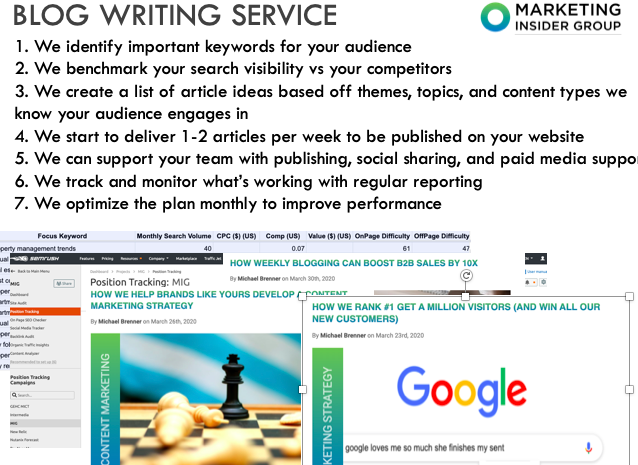
What Is a Blog Writing Service? (And Why Your Business Needs One)


Blog-writing-service

“What is a blog writing service?” you ask. Glad you did.

Here’s the deal. Businesses who put blogging at the top of their marketing strategy are 13 times more likely to experience a positive ROI, according to HubSpot.

B2B companies will generate 88 percent more leads, while their B2C cousins will generate 67 percent more leads through publishing blog posts consistently. That’s a lot of leads to leave on the table if you’re not blogging.

Furthermore, in today’s digital world, your website is more important than ever to get your brand out in front of likely customers. When you blog, you’ll get 97 percent more links to your website, marketing news site Business2Community points out.

And the leads you generate will cost 62 percent less than ones you generate through advertising, cold calls, brochures, or other outbound marketing methods.

With three-fourths of all Internet users reading blogs regularly, your company needs to get on board the blogging train. Imagine what could happen if you missed out – and your competitors get:

That 67 percent cost reductionThat 88 percent increase in leadsOr, that 97 percent more links to their website?

I thought so. Bottom line, you need a blog to stay ahead of your competitors.

Quick Takeaways:

Having a blog is essential to wooing today’s information-hungry customers.Most businesses don’t have the time, expertise, or budget to hire an in-house writing team.A blog writing service can turn your subject matter expertise into expertly written content.

Content Marketing Is a Must for Today’s Businesses

“But,” you say, “I’m busy just running my business. I don’t have any time to write a blog. Besides, I practically got through English Composition 101 by the skin of my teeth. I’m an engineer/doctor/web developer/financial services professional, not a writer.”

That’s where a blog writing service comes in handy. Content marketing – of which blogs are a huge component – is one of the most effective lead generation strategies in the marketing world.

A blog writing service is a company with specialized content writers who combine their industry knowledge with keen research abilities to create regular blog posts. Their posts leverage the blog writers’ abilities to communicate to propose solutions that can help your customers solve the problems that keep them up at night.

With a blog writing service, you won’t need to forgo time with family and friends to stress out over this week’s blog posts. You and your team can do what you do best and leave the writing to the writers.

Build Industry Authority and Customer Visibility

And you are good at what you do. Only problem – not enough of the right people know just how good you are. Blogging helps you showcase that expertise without spending a moment of your time.

Having a blog writing service builds your authority in your industry in the minds of people who might not even have heard of your company before you launch your blog. When you couple that exposure with your social media reach by posting links to each post on your social media pages, it’s sheer marketing magic.

Furthermore, with every blog post you publish, your visibility on your target customers’ searches rises. A blog writing service will know how to leverage the right keywords and metadata to get both search engines’ and your target audience’s attention.

Create Newsletter and Other Gated Content

Your blog writing team can also create extra content that you can send to your email newsletter subscriber list. These articles can take a deeper dive into material that you covered in your blog posts or provide insight into topics you haven’t yet covered in your blog posts.

As a vital component of your content marketing strategy, your email newsletter can serve as the next step along the customer journey for those people interested enough in your blog content to subscribe. Providing expertly written, highly informative information in every newsletter will spark even more interest in your company, positioning you as a thought leader in your industry.

An email newsletter works equally well for B2C companies as well as B2B businesses. Statistics show that email marketing yields a whopping 4,400 percent ROI, yielding $44 for every dollar spent.

In addition, you can expand these newsletter articles into new content, such as white papers and e-books, that delve even deeper into the subject matter for those considering a purchase.

Use Your Blog Writing Team to Craft Account-Based Marketing Messages

For B2B companies, you can even repurpose your blog post into personalized content in one of today’s hottest marketing strategies – account-based marketing. With a blog writing service, you’ll have a team of writers who know your company and its work – and can craft content tailored to each decision-maker’s interest.

For example, you could send a manufacturing company’s head engineer an article about how your new widget can shave hours off the manufacturing process, while the chief financial officer would appreciate an infographic about how much money the company would save by putting your widget to work in the process. Their developer, though, would love an article about the way you put Agile methodology to use as your team created the device.

When B2B companies align their blog writing service with their sales team to leverage the power of account-based marketing, they’re likely to boost their ROI. Forty-two percent of all companies that do so experienced significantly higher ROI, while 42 percent of the companies experienced somewhat higher ROI.

Turn Your Expertise into Compelling Content

You and your teams have a ton of expertise in your field. A blog writing service can work closely with your teams to turn raw facts into compelling copy.

Let’s say that you’re a pharmaceutical company, and you’ve come up with a new cure for an emerging disease. Your blog writing team can work with your researchers to turn their latest study into easily understandable content that busy physicians and nurses can scan quickly.

Your blog writing service can take testimonials from physicians that have tried your new drug successfully and craft blog posts that patients can understand. With more information, patients can be more informed when they have conversations with their own physicians.

For startups, whose lean budget doesn’t leave much room for marketing, let alone a dedicated content writing team, having a blog writing service at their disposal can be a game-changer.

Use Your Blog Writing Service to Repurpose Existing Content

Just like your other assets, your blog content can do double duty when you repurpose it in other formats. Use your blogging team to transform blog posts to how-to video scripts, to create catchy product and service descriptions for Instagram and Pinterest, and to rephrase the content as compelling personal stories on Medium. Take a video and turn it into a LinkedIn article that showcases your thought leadership.

A blog writing service has experienced content writers that can adapt your existing content into practically any written form you want. They can even rewrite past content to make it more search-engine friendly. That way, you can reach even more people who need your expertise.

Finally, when you hire a blog writing service, you won’t have the added expense of an in-house writing team, nor will you need to spend your time recruiting and onboarding each team member. With an outsourced blog writing subscription service, you’ll have a team of writers that someone whose expertise is content creation has recruited, tested, onboarded, and proven through project after project.

If you are ready to get more traffic to your site with quality content that’s consistently published, check out our Content Builder Service. Set up a quick consultation, and I’ll send you a free PDF version of my books. Get started today and generate more traffic and leads for your business.

The post What Is a Blog Writing Service? (And Why Your Business Needs One) appeared first on Marketing Insider Group.


By: Michael Brenner
Title: What Is a Blog Writing Service? (And Why Your Business Needs One)
Sourced From: marketinginsidergroup.com/content-marketing/what-is-a-blog-writing-service-and-why-your-business-needs-one/
Published Date: Mon, 20 Apr 2020 08:08:41 +0000


For More Information about our services please visit:

Fuseology Creative SEO Marketing Agency
1509 NE 83rd CT
Vancouver, WA 98664
360-602-2655

Additional Informational Links:


Fuseology Creative, by fuseology

What’s Trending: Getting Up to Speed


Getting Up to Marketing Speed
>

The new trend going around social media is people showcasing what they’re doing with their “extra time.” If you are able physically and mentally to pick up a new hobby, plow through your reading list, or take online courses right now, that’s great! 

If, on the other hand, you’re stressed out, cooped up, and not really finding all that “extra time” others are talking about, don’t feel bad. Most of us are experiencing this as a challenge, not an opportunity. But fortunately we can lean on one another for support, ideas, and encouragement.

This week, I went looking for resources to help all of us continue to adapt both our marketing and our workload. I found a few solid ways to get back up to speed, and some inspiring examples of brands that are doing great marketing right now.

1. Apps and Tools to Keep You Productive and Sane

If you’re struggling with organization, focus or productivity as you work from home, this longform article from Clare McDermott is a godsend.

The original article is from 2018, but Content Marketing Institute updated it as it’s especially relevant right now. “How do super creative and productive people get through the daily grind ... yet still manage to preserve their creative energy?” she asks. “They, in part, optimize technology.” This post is all about the free or inexpensive tools you can use to keep orderly and productive.

Clare includes perennial favorites like Evernote and Asana, but you’ll also find some more obscure solutions that could help lighten your workload. The most intriguing for me: Mixmax, a highly customizable email automation tool that plugs into Gmail.  

It may be tempting to go all in on these 16 tools, but Clare suggests taking a more measured approach. 

“Always add apps one at a time to your toolkit, particularly plug-ins or add-ons ... to existing apps,” she says. In addition to the potential for technical difficulties when apps work together, you risk overwhelming your brain with too many changes at once and losing what productivity you might have gained.

2. What Readers Want During COVID-19

The title sounds like this will be a platitude-filled thought leadership piece, full of lofty observations about being useful, kind, and relevant. That would be all well and good, but Amanda Milligan aims for something more substantial and practical here.

Amanda spent hours analyzing search trends for various keywords across multiple verticals. With that research, she’s able to recommend types of content that people are searching for in connection to industries like travel, education, healthcare, and more.

Regardless of what specific content your audience is looking for, Amanda suggests you can’t go wrong with positivity: “If you’re not responsible for delivering breaking news or important COVID-19 updates, look for opportunities to amplify joy, gratitude, hope, or any other positive emotion. People are looking for health and safety updates, but they’re looking for inspiration, too,” she says.

3. 12 Ways to Adapt Your Marketing in Times of Forced Isolation

As we said in the last couple of roundups, now is not the time to pause or stop marketing altogether. Carole Alalouf agrees: “If you build and maintain your brand through hard times, you can position yourself as a trusted, reliable and reassuring presence in your industry,” she says. What’s more, “As other brands cut back on their marketing efforts, you can stand out and improve your competitive advantage by investing wisely in the right tactics.”

For Carole, adapting your marketing to the current environment involves both reshaping your messaging and exploring new tactics. First, make sure your automated ads, emails, and newsletters are updated to be sympathetic and sensitive. People are experiencing everything from anxiety to grief right now — if you’re putting a message in front of them, it has to be relevant in that context.

Once your messaging is in order, Carole recommends developing 12 tactics that will serve both now and in the future. If you haven’t crafted a video marketing strategy, or if you’re lacking an email newsletter, this article can help you get started.

4. Brands Getting Email Right During a Crisis

Speaking of messaging: It can be challenging to determine just how much or little your brand should say about a crisis. If your brand voice is playful or casual, is it time to send out a staid, formal email? Do you risk looking irreverent, or go the other way and risk seeming disingenuous?

These examples from Jodi Harris can help you thread the needle. She highlights examples of companies that kept their brand voice, expressed sympathy, and kept customers informed about the pandemic. I’m particularly impressed with Two-Bit Circus, an amusement park with a lighthearted, irreverent brand voice. They kept the humor, but added a little infusion of sincerity and warmth to go along with it. The resulting email sounded more genuine than any straight-faced “keep it professional” message would have. 

Make the Most of Your Time

There’s no shortage of memes and images out there telling people to make the most of their time during the quarantine. But what they don’t say is that “the most” means something different for everyone. If you put in a 10-hour workday and got in a workout before your mandolin practice, that’s amazing. If you got your kids lunch on time, helped them with their remote schoolwork, and finished a few essential tasks for work, that's amazing, too. Keep doing what you can, push yourself when you can, and remember that it’s not a competition. 

>


By: Steve Kearns
Title: What’s Trending: Getting Up to Speed
Sourced From: business.linkedin.com/marketing-solutions/blog/what-s-trending-in-marketing--top-content-of-the-week/2020/what-s-trending--getting-up-to-speed
Published Date: Mon, 06 Apr 2020 05:00:00 -0700


For More Information about our services please visit:

Fuseology Creative SEO Marketing Agency
1509 NE 83rd CT
Vancouver, WA 98664
360-602-2655

Additional Informational Links:


Fuseology Creative, by fuseology

Sunday, April 19, 2020

Advertising in Recession — Long, Short, or Dark?


Advertising in a Recession
>

Editor's Note: This guest post was contributed by Peter Field, a B2B Institute Research Fellow. 

Executive Summary

As I write this, it looks increasingly certain there’s going to be a recession. It will probably be different to ‘normal’ recessions, but much of the lessons about advertising from previous recessions still applies:

>Continuing to invest in brand advertising is recommended (if resources are available) but there is a diminished role for short-term sales activation in the current crisis due to consumer demand patterns, with a few exceptions. Data from the 2008 recession shows the value of investing in brand.Featuring humanity and generosity in advertising are advised: the use of emotions and humor can be helpful.Demonstrating humanity and generosity through behavior is also advised: brands should ask themselves the question, 'how can we help?'

Keep Calm and Carry On

Even as we wait to discover just how great the impact of the COVID-19 virus pandemic is going to be on economic activity, it now looks almost certain that there will be a recession. Though governments will move heaven and earth to ensure that it is as short and as shallow as possible, the temptation for many in the business world will be to cut marketing and advertising costs to the minimum, especially if this is their first recession. The same uncertainty about what to do was evident in 2008, at the start of the Global Financial Crisis, when no one was sure how bad things would get and the natural temptation was to assume the worst. But is that the best approach? And can we learn anything from previous downturns that will help us weather this one and emerge stronger?

> During the last recession in 2008-9, I wrote a report for the IPA (Advertising in a downturn, IPA 2008) that pulled together expert evidence on the best way for brand owners to manage advertising budgets. Much has happened in marketing since then, including the publication of >The Long and The Short of It in 2013, in which Les Binet and I revealed the risks of one common response in 2008: the shift to short-term sales activation.>

In this article, I have examined the IPA data from around 50 case studies covering the 2008-9 recession period: while limited, the data nevertheless reveals how different investment and strategic approaches performed then. The data source is the compulsory confidential data submitted alongside entries to the IPA Effectiveness Awards competition in early 2010. The data covers inputs such as advertising strategy and budget, and a number of business outcomes, such as share and profit growth, allowing us to form a view about how the former influences the latter.

The first caveat is that what we face is unlikely to be a ‘normal’ recession: it will be the first disease-driven recession of the modern era. Already it is playing out in very unusual ways. As in most recessions, the effects depend greatly on the sector: people still have to eat and take care of themselves but can delay discretionary purchases. Already the difference between essential and discretionary purchasing looks like it will be much more pronounced than in previous recessions. Thus far, many essential categories have been characterized by elevated or even panic buying, not the more usual deferral or down-trading, so what should brands in these categories be doing?

The answer largely depends on how scalable the business is and how flexible its delivery. For most physical products and services, demand is exceeding the ability to supply, but scalable businesses delivering important needs to house-bound customers, such as TV stations and video conferencing platforms that are not dependent on workplace usage, are fortunate exceptions. They are enjoying – and meeting – bumper demand, so there is a strong case for these businesses to exploit short-term demand (by means of lead generation activity) to build long-term market share. Brand building and short-term sales activation both make perfect sense for these brands in the current crisis. For the many brands that are unable to meet demand, however, extensive use of short-term sales activation would make little sense. But, for them, does brand building at such a time make any more sense? Can continued brand advertising signal important reassurance? With appropriate sensitivity to the fearful state of most people, brand building may in fact be the best approach, as we will see.

> With appropriate sensitivity to the fearful state of most people, brand building may in fact be the best approach, as we will see.>

In some discretionary categories where revenues have fallen to levels that threaten the survival of companies, such as airlines and catering, there may be no choice but to cut all advertising to conserve cash. In these situations, where goods or services may not be deliverable, or customers non-existent, there is certainly no point in trying to attract short-term buying. But, if the resources are available, the arguments in favor of brand building are stronger. This may not be in the form of costly conventional advertising but could perhaps involve eye-catching initiatives that reflect the mood of the times. Already we are seeing acts of generosity and humanity by some companies – these are praiseworthy in their own right and help to support the morale of staff and stakeholders during the crisis. But these acts also help to keep the brands salient and hopefully create positive emotional associations that will prime or remind future purchasers when markets recover.

The effect on B2B markets will be complex, with many differing sector-specific patterns. In many cases, they will be as severe as the worst of B2C. As we have seen in China, now is not a good time to be a sub-contractor for a business serving discretionary consumer markets (e.g. automotive). With many employees now working from home, there is also likely to be a big impact on goods and services that support the workplace, unless they can pivot to support working from home.

> Now is a good time for these businesses to be building market share through a balanced mix of brand building and sales activation, assuming they can meet demand.>

On the other hand, businesses supporting those that serve essential consumer markets, or the current colossal shift to working from home, are more likely to see smaller or even positive impacts. Now is a good time for these businesses to be building market share through a balanced mix of brand building and sales activation, assuming they can meet demand.

But for B2B businesses whose customers and prospects are unable to buy, or who cannot meet existing customer demand, pursuing bottom-of-funnel, short-term, sales activation makes little sense unless it can help shore up existing relationships. For these brands, investing in long-term relationship-building is a better path forward. For the many activation-focused B2B brands, this will necessitate quite a shift in strategy.

> Because the sales funnel in B2B purchasing is generally longer than in B2C, the arguments in favor of supporting long-term growth through brand building are likely to be even stronger than in B2C. B2B Brand associations created now are likely to bring the greatest sales benefit during the recovery period, precisely when the rewards are biggest. Brand advertising is not about profiting in recession, it is about capitalising on recovery.>

Historically, most recessions last around a year, sometimes five quarters. Hopefully, this pandemic will not last long enough to extend the duration of the recession beyond ‘normal’. Pandemic-based downturns tend to be v-shaped and during the last 100 years most have lasted around a year, according to the Harvard Business Review. This means that when all restrictions are finally lifted there is likely to be an enormous collective release of pent up demand, something wise businesses will be prepared to service well. A sharp recovery would be a departure from ‘normal’ recessions of the past, so the lessons from past recoveries may need to be reconsidered given this is an unprecedented, disease-driven downturn.

Reconsidering Lessons from the Past

The lessons for the marketing profession from the 2008 recession in the UK, for example, were clear, but they may not apply fully to our current situation. So with that in mind, to what extent should those lessons apply now?

Focus on the Long Term

In the last recession, some advertisers cut brand advertising spend, assuming this to be prudent, and many established media saw advertising revenue fall by 20% or more. However, because this was also the early period of big data, online advertising revenue actually grew by about 20% in 2008. Overall, advertising spend held remarkably steady, but it was the start of a dramatic drift to short-term activation media, something that has cost businesses dearly over the years since then. The IPA Databank allows us to examine how the balance between long-term brand building and short-term activation influences the effectiveness of a campaign. In normal times, the IPA data argues for a balance between brand and activation spend in the ratio 60:40 for maximum business effectiveness.

> Most businesses today already spend less than 50% on brand-building – dangerously below our recommended 60% – so there is certainly no sense in cutting brand building further unless survival depends on it. >

The IPA data on how campaigns balanced brand and activation spend was less extensive back in 2008, so there is some uncertainty in the findings, but the data suggests that a slight shift from the 60:40 optimum towards 50:50 might have been sensible in 2008. However, because of the highly unusual impacts of this pandemic, from panic buying in some categories to market shut-down in others, this is unlikely to be best practice during this recession. Short-term activation makes much less sense, when either demand cannot be met or simply doesn’t exist. And in any case, most businesses today already spend less than 50% on brand-building – dangerously below our recommended 60% – so there is certainly no sense in cutting brand building further unless survival depends on it. Either way, it looks like a greater focus on brand advertising investment rather than on short-term sales activation is more sensible from here on in. Certainly, businesses should resist the seductive sales pressure from short-term media to increase activation spend, unless they are one of the fortunate few countercyclical businesses that can meet demand.

Defend Your Share of Voice

In 2008, some brands cut their Share of Voice (SOV – the percentage of category advertising expenditure spent by the brand), while others raised theirs. We know that SOV is strongly correlated to market share – if we allow SOV to fall below the brand’s share of market then market share is likely to fall over the year following. We therefore know that cutting advertising budgets – and SOV – during a recession is a risky strategy. It may provide some short-term relief to profitability (because costs are cut), but the subsequent loss of market share that follows will be extremely difficult and expensive to regain during the recovery. Thus, the long-term impact on profitability will be highly damaging and it is better to take the short-term profitability hit to maintain SOV and defend the brand.

> The good news for businesses that defend their brands is – because some advertisers will pull budgets thus reducing category ad spend – maintaining SOV is likely to be cheaper than in normal times. >

The good news for businesses that defend their brands is – because some advertisers will pull budgets thus reducing category ad spend – maintaining SOV is likely to be cheaper than in normal times. Of course, predicting what SOV a given budget will achieve in a rapidly evolving media environment can be difficult, so defending SOV likely requires a highly adaptable approach.

Seize Your Market Opportunity

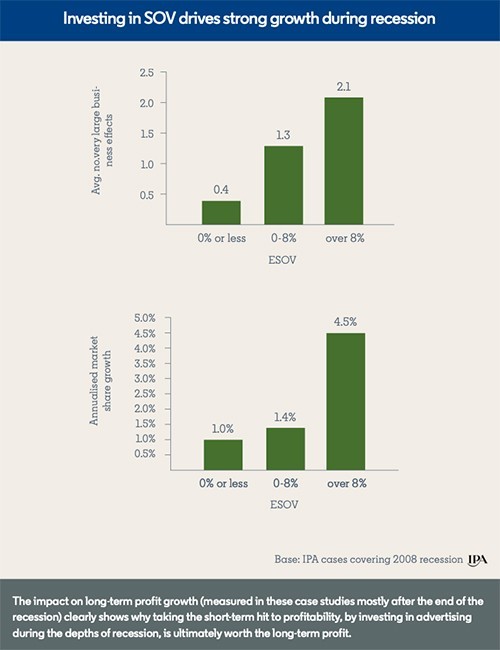
The implication of falling SOV costs is that recessions can be a low-cost growth opportunity for brands. But in this recession, we can also add the opportunity presented by a house-bound population’s growing usage of media such as TV, social and online news channels. We saw in 2008 that the brands that took advantage of lower SOV costs to boost their SOV achieved impressive business gains. The following charts examine three equal-sized groups of cases from the 2008 recession with different media investment strategies measured by ESOV (the difference between share of voice and share of market – the key measure of investment). Group one, whose ESOV was zero or less were at maintenance levels or lower, but were still advertising (i.e., they had not gone ‘dark’). Group two had modest growth levels of ESOV in the range 0-8%. Group three saw the recession as an opportunity, with over 8% ESOV. Remember that some of these brands will have merely held their spend level to achieve this level of ESOV. That said, the investors saw 5 times as many very large business effects (such as profit, pricing, share, penetration etc.) and 4.5 times the annual market share growth.

> That said, the investors saw 5 times as many very large business effects (such as profit, pricing, share, penetration etc) and 4.5 times the annual market share growth. >

Add to this the general finding that stronger brands are more resilient to adverse events, and you have a fairly compelling argument for investment.


Demonstrate Humanity and Warmth

The appropriate tone of advertising in this recession may be different from previous ones and may change over time, so we need to keep a close eye on the live guidance provided by continuous market research studies. In this crisis we are not yet dealing with an elective decline in consumption but an enforced one that, at least for the time being, has implications for the tone of advertising. A broad group of marketers have expressed concern that continuing to advertise as usual might risk alienating consumers. Market research company System1, who measure consumer response to new ads on a daily basis in the US and the UK, are not yet seeing any signs of “ad alienation” (as of 20th March 2020) due to the introduction of social distancing. Put another way, people are not changing previous buying attitudes, they are simply prevented from exercising them. So, early research findings appear to suggest that fears about continuing to run existing advertising may be overstated.

> So, early research findings appear to suggest that fears about continuing to run existing advertising may be overstated.>

This may change in time if the recession is deep and long enough, but because the most likely shape of recession is relatively short but sharp, we shouldn’t yet fall into the recessionary advertising mentality seen in 2008. This was characterized by a shift away from purely emotional advertising as advertisers felt more serious approaches fitted the mood of the people. The IPA data suggests that there might have been some limited justification for this in 2008, to the extent that campaigns that supported emotional platforms with rational content appear to have enjoyed improved effectiveness, but this is from a base of low effectiveness in normal times. In fact, many of the most celebrated effectiveness case studies of that time were emotional feelgood campaigns – albeit rooted in the reality of what the brands did for customers, rather than abstract emotional ‘wash.’ Examples include Heinz, T-Mobile, Virgin Atlantic, Hovis Bread and Cadbury.

A couple of sentences from the T-Mobile IPA case study are worth revisiting now: “Our research showed that people’s deeper human values were coming more to the fore. As the recession bit, people were responding in kind – literally – by turning to friends and family with warmth and good humor where we might have expected angst and despair.” T-Mobile built this insight into their highly effective campaign during the recession.

> It is too early to tell whether the mood of populations will turn against ‘business as usual’ advertising, but for the time being we should expect the key virtues of emotional advertising to hold true even during recession: priming long-term buying of brands more powerfully than rational advertising, making a bigger impact on price sensitivity, and reducing pressure on pricing. So long as the emotional platform is sympathetic to the prevailing mood, the arguments for consistency probably outweigh those for change.>

This in no way undermines the value of highly topical opportunities to build goodwill through acts of humanity and generosity. This recession is unusual in that having a common enemy – COVID-19 – has generated a level of community spirit (toilet roll panic buying aside) that far exceeds that seen in previous recessions. If people are demonstrating solidarity in adversity, then brands doing the same thing will earn their respect. Many farsighted companies have willingly offered free goods and services to mitigate the emergency or to shield their employees from insecurity. Others have behaved less well so far. It doesn’t take a psychologist to unravel who will benefit most in recovery.

Guidance for this Recession

So, here are seven guidelines derived from adapting previous lessons to this very new situation:

>Do not hit the panic button and withdraw brand advertising, unless short-term survival depends on it.Resist the pressure to switch advertising spend from brand solely to activation – it makes very little sense to do so, even in the short term. Customers, in many cases are not reluctant to buy, they are unable to buy. If the resources can be found, aim to maintain your share of voice, ideally at least at the level of your market share, where SOV equals SOM. You may even be able to reduce your budget if others are cutting theirs but be ready to adapt quickly to developments. You will need to monitor competitive activity regularly.If the resources can be found, consider the opportunity to invest in lower-cost long-term growth by increasing share of voice during the recession.Do not abandon your existing brand campaign unless it is clearly unsympathetic to the mood of customers. There may be more value and reassurance in continuity than in change.Do not be frightened to use emotional brand advertising during recession – but ensure it is appropriate to the mood of customers. System1’s live research findings are right now supporting the use of advertising that demonstrates humanity through warmth, generosity and humor.Look for tactical opportunities to create goodwill through acts of humanity and generosity, especially if you were proclaiming these virtues before the emergency.

The coming months will test everyone – we are in uncharted territory. But this was much the same in 2008 and it was the brands that held their nerve – and share of voice – that bounced back strongly when recovery came.

>


By: Peter Field
Title: Advertising in Recession — Long, Short, or Dark?
Sourced From: business.linkedin.com/marketing-solutions/blog/linkedin-news/2020/advertising-in-recession-long-short-or-dark
Published Date: Mon, 06 Apr 2020 16:00:00 -0700


For More Information about our services please visit:

Fuseology Creative SEO Marketing Agency
1509 NE 83rd CT
Vancouver, WA 98664
360-602-2655

Additional Informational Links:


Fuseology Creative, by fuseology