
Many of the nation’s largest companies haven’t moved beyond the days of the “mad men” of Madison Avenue’s ad campaigns when it comes to marketing.
Major ad agencies still control the purse strings for these enterprises’ ad spend. Yet the very tactic that entrepreneurs have used to snatch away some of these companies’ business—content marketing—can work just as well for legacy enterprises as it does for startups. To be successful, though, an enterprise content marketing strategy must conquer some key challenges that enterprise marketing teams face.
Quick Takeaways:
Enterprise companies’ size, scope, and siloed structure often stand in the way of great content marketing.Those who struggle aren’t alone: statistics show a majority of large companies face content challenges.A centralized content team can help overcome challenges.Leverage Agile methods and break up silos to create revenue-building content.
Enterprise Companies Often Struggle with Effective Content Marketing
More than attachments to traditional advertising challenge those enterprises who haven’t taken full advantage of content marketing. Other factors, too, keep them from leveraging their marketing power through quality content.
The Content Marketing Institute (CMI) conducted research that identifies common challenges that hamper enterprises from doing effective content marketing. They are:
60% of the companies studied identified departmental silos as a barrier to content marketing74% of them struggle with coordinating content marketing across brands and departments50% of them can’t leverage content technology adequately throughout the company49% of the enterprises resist change, even with the rise of Agile methodology45% of the companies surveyed had trouble maintaining consistency in their messaging
All but their resistance to change, we would argue, come from the companies’ sheer size and often siloed departments.
Because enterprise-level companies often use major TV and print campaigns to get their message across, their default marketing budget usually flows to legacy ad agencies. The result? One-off ad campaigns supported online with references to their TV and print ads.
As for digital display ads, statistics tell a “horrifying” story, as Carly Stec points out in her HubSpot article. Not only is the use of ad blockers growing but also, stats point out that nearly half of customers’ clicks on mobile ads are “accidental.”
In fact, readers who don’t click do so intentionally since more than 54% of readers don’t trust such ads.
Ouch—for those enterprise companies who think that display ads are taking advantage of cutting-edge digital technology.
For example, take a look at Coca-Cola’s website. Slick photos, self-promotional stories, and chances to win football tickets abound, yet there isn’t a blog in sight. After you search, open up another tab, just for fun.
Chances are the retargeting bots will chase you to your default search page. But when you click on the retargeting link, you see the smiling faces of sports journalists, all enjoying a Coke—all a not-so-subtle reference to current Coke ads for the fall football season.
Perhaps Coke doesn’t need blog posts to fish for new markets. That’s a mistake, in our opinion.
No matter how large your company is, it can always grow through discovering new markets. Those markets aren’t likely to switch their beverage of choice from a catchy ad. They’ve seen them ad nauseam when they watch the nightly news or their favorite team.
If only the beverage maker would go after the foodie market with content that extols the beverage’s natural affinity with food. A few recipes from well-known chefs and home cooks alike that recommend pairing suggestions with one of Coke’s signature offerings might win Coke a new customer base.
After all, great marketing was part of beer’s evolution from a proletarian beverage to gourmet tastings at tony restaurants.
So far, though, Coke hasn’t pulled the content marketing genie out of the bottle yet. Perhaps they don’t have the people with the foresight to do so. Or maybe, like many enterprises, they’re stuck in the last century when it comes to content marketing.
Some Enterprises, Though, Get Content Marketing Right
It’s easy to get stuck in a rut and keep publishing the same old blog posts and articles month after month. But to truly succeed at enterprise content marketing and stand out from your competitors you need to mix things up, take risks, and think out of the box.
There are some enterprise companies, though, who have unleashed the content marketing genie. If you’re in need of a little inspiration for your content marketing strategy over the coming months, take an idea or two from these real-life examples of truly innovative and effective enterprise content marketing. And then think about how you can brainstorm how to apply these innovations into your own blog content – consistently, over time.
1. IKEA
IKEA are well known for their innovative approach to furniture design (as well as their meatballs!) but they’ve also produced some killer content in recent years, ensuring they stay well ahead of their competitors and a favorite brand in the eyes of their customers.
In an industry that’s all about the visuals and the experience, blog posts and other textual content simply aren’t going to be effective. Instead, IKEA relies mainly on image and video content to get its message across. The IKEA catalog itself is an example of hugely successful traditional content marketing, and the company prints over 200 million copies every year.
The print catalog is now accompanied by a digital version, which includes additional immersive experiences such as an augmented reality app that allows users to see how IKEA furniture will look in their own home.
IKEA has also harnessed the power of user-generated content on their IKEA Family Magazine Instagram account, reposting images of IKEA furniture and accessories in real homes all over the world.
The brand is also known for their quirky YouTube videos, which include storage ideas, home tours, and even an “Oddly IKEA” series that latched onto the growing trend for ASMR – videos consisting of sounds that give the listener a pleasant tingling sensation.
2. IBM
IBM has created several memorable content marketing campaigns over the years. Their YouTube account is one of their main content marketing channels and includes a mixture of promotional and informational videos including “Ninjas vs Superbugs: Adventures in Nanomedicine”, “World’s First Cognitive Dance Party”, and “THINK: A film about making the world work better”. Some of the videos have achieved millions of views.
The global IT brand is now positioning itself as an industry leader in the marketing technology niche with its Watson AI platform that enables users to build chatbots, personalize customer experiences, and carry out advanced data processing with the power of AI and machine learning. Many of IBM’s marketing campaigns are now powered, at least in part, by Watson.
One example is their “Cognitive Cooking” campaign powered by “Chef Watson”. This was in the form of an app and a printed recipe book that users could buy. The platform used Watson to combine ingredients into unique flavor combinations after analyzing 10,000 recipes from Bon Appétit. Some of the recipes invented by Chef Watson included rye whiskey stir-fry, avocado, and tomato gazpacho soup, and blackberry-cherry cobbler with honey whipped cream.
IBM also frequently works with bloggers and key influencers to reach targeted audiences and build their brand trust and authority.

3. Bank of America
The Bank of America partnered with the Khan Academy to produce their “Better Money Habits” site – an educational personal finance site that includes interactive tools, quizzes, informational articles, and a video series following the career stories of young people and how they manage their money.
In a subject as dry as finance, it’s vital to keep content fresh and engaging and The Bank of America achieved great success with this, using just the right level of illustrations, infographics, and interactive elements to make the content more interesting and easy to understand without being condescending.
Financial service providers also have a problem in that much of their content appears similar and it can be difficult to maintain a strong brand presence through their content. By adding a human touch and providing real value to their users, the content not only makes the brand more memorable but also increases its trust in an industry that consumers are traditionally suspicious of.
4. Salesforce
B2B companies often seem stifled and stuffy in comparison to their B2C peers when it comes to content marketing. However, Salesforce is a great example of how to do B2B content marketing well in a way that’s both creative and educational.
Salesforce built Trailhead – a free interactive learning tool – both to improve the user experience of its existing customers and to create a substantial hub of high-quality content for SEO purposes.
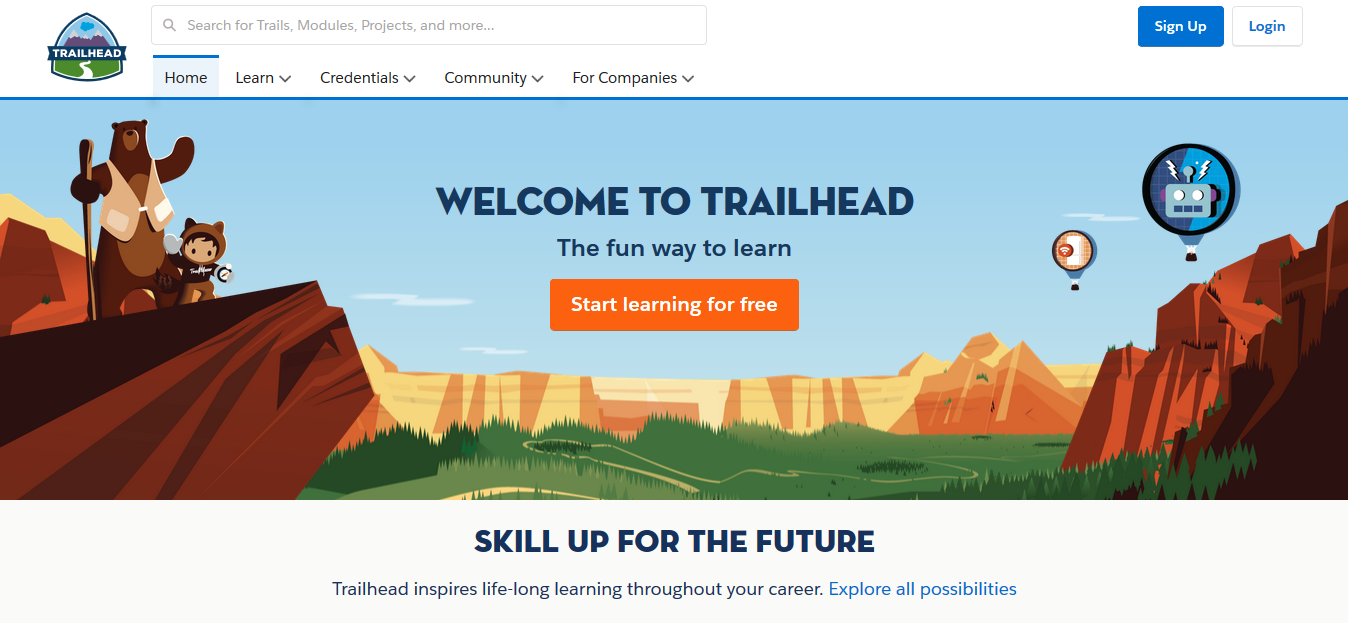
The meat of the content on Trailhead consists of educational modules to teach the user various Salesforce skills. Modules are extremely user-friendly, split into individual units with clear guidance on how long each will take to complete. To make the experience more fun, Salesforce has gamified the platform so users earn points for completing each module. They can also “choose an adventure” and earn a badge with short tutorials.
Salesforce has also laid out information into various Salesforce career paths, including administrator, developer, marketing manager, and business analyst. Visitors to the site can see information about each career, such as average salary and annual growth rate, and then be guided through the Trailhead learning platform in the modules aimed at this career path.
5. Birchbox
It can be challenging for e-commerce brands to produce content that doesn’t seem overly promotional, but subscription beauty brand Birchbox has achieved just the right balance with their individual online magazines for men and women.
As well as features on the actual products on offer, Birchbox publishes informational content such as “The ABDEs of Melanoma”, product tutorials, customer profiles, how-tos, and style inspiration.
The content perfectly fits the formula for being shareable on social media, including trending topics, “hacks”, listicles, and clickbait titles. Some example articles include:
How to ‘Marie Kondo’ Your Beauty ProductsWe Gave 4 Weird Wellness Trends a Spin – Here’s What Happened8 Ways to Hack Your ShaveThe 5 Habits That Will Get You Out the Door Faster.
Much of Birchbox’s content is video in the form of makeup and hair tutorials, which makes sense for the type of products it sells, and are also highly appealing for their mainly millennial audience to share on social media.
The company also benefits from user-generated content, with thousands of Birchbox “unboxing” videos on YouTube. Birchbox contents photos are also widely shared on Instagram, partly due to the thought that goes into the product curation and packaging.
Birchbox is one brand that’s successfully using the live video trend for content marketing. It streams weekly on Facebook with a Q&A format that’s presented by Birchbox employees. This live content gets around 4x the engagement than other types of content on the platform.
Birchbox’s strategy may be one of the simplest on this list but it’s one that works. The company has grown from 600 subscribers in 2010 to over a million in 2019, with 2.7 million likes on Facebook.
5. Progressive
Progressive Insurance’s in-house marketing team creates plenty of catchy TV ads, but they also have a blog on their website, chock-full of content that attempts to answer all the questions prospective customers may have.
Progressive has set aside an adequate budget, giving their team the scope they need to create not only catchy ads but also meaty content that pulls customers in by meeting objections with stone-cold facts. That’s the kind of marketing that works hand in hand with the sales team to build a foundation that makes selling their policies that much easier.
Their catchy ads pair with informative content on the website itself that continues to draw customers away from older, more conventional companies.
Here are some more B2B content marketing examples, in case you haven’t seen enough!
The Solution: Create a Core Content Team (or Outsource)
What we recommend is to create a core content marketing team that defines the style and brand guidelines, ensuring consistency of message.
That team must keep up with all the latest developments in content creation and distribution technology. Yet instead of becoming a siloed department itself, an enterprise content team must reach out to employees from all departments, encouraging them to produce content as well.
With detailed, easy-to-understand guidelines that define style and brand voice, employees can post on social media without fear of reprimand. Working with a content team, engineers, for instance, whose strengths don’t lie in writing, can create rough drafts that explain how the company’s latest gadget works. The content team can then edit the drafts to create informative, easy-to-read explanations and instructions.
This strategy has brought unbridled success for some of the nation’s most forward-thinking enterprises. Deloitte—yes, even that legacy financial advisory company—along with Reebok, Starbucks, and Dell, all have successfully implemented employee content sharing programs.
No matter how large your company is, a carefully coordinated content marketing team can reach new customer segments that you’ve struggled to reach, increasing your company’s revenue and elevating its brand image even more.
Partner with the Sales Team to Inform Prospects
Marketing and sales are two sides of the same coin. Both teams’ focus is on increasing the company’s customer base, and ultimately, its revenue.
So, why do many enterprises’ sales and marketing teams exist in silos, barely speaking to each other in the halls, let alone coordinating marketing and sales campaigns with one voice?
Effective content marketing can lay the groundwork for effective sales in both B2C and B2B enterprises. Progressive’s content team, for instance, addresses many of the objectives and concerns prospective customers might have through well-informed blog posts.
By the time the customer gets to a salesperson, many of the questions and objections they might have otherwise raised with the salesperson have already been answered. The customer is primed to buy.
For B2B companies, personalized messaging that addresses the various concerns of every decision-maker can help sales personnel not only land a meeting but even more importantly, clinch the sale.
Targeted messages to the prospect’s engineering department about the structural integrity of the building material the salesperson is trying to sell can clear the way of roadblocks, while assurances that the building material has an airtight guarantee will please the legal department. Partnering with the sales department is one of the best strategies to assure enterprise content marketing success.
dopt Agile Principles to Market Your Enterprise More Effectively
Your firm doesn’t have to be a startup or a tech company to take advantage of Agile principles when it comes to content marketing. We would argue that it’s a necessity to take an enterprise successfully into the next decade.
Without Agile methodology, marketing campaigns are slower to test, slower to get results, and it takes more time to tweak a content campaign to make it fit customers’ needs. Agile principles emphasize testing ideas on customers early on, acting on their feedback, and changing direction accordingly.
An Agile content strategy will respond more quickly to news stories that affect the market. Agile content marketing can adapt to breakthroughs in technology, leveraging them to their company’s benefit.
Combining Agile principles with the larger number of resources an enterprise company can provide can scale successful campaigns more easily, as Monica Georgieff points out in her article. Not only that, but teams can innovate faster than ever before—without the top-down bureaucracy needing to approve every sneeze that comes out of the marketing team. Agile methodology is one of empowerment both for the innovators and the end consumer, in this case, potential customers.
Most importantly, going Agile in the marketing department as well as with your product development can give you the edge over scrappy upstarts that threaten to corner the market on whatever you sell. If you’re involved with an enterprise company who wants to jumpstart its content marketing program, you don’t have to break the bank to hire an in-house team. Outsourcing to a content marketing agency is a great place to start.
If you are ready to get more traffic to your site with quality content that’s consistently published, check out our Content Builder Service. Set up a quick consultation, and I’ll send you a free PDF version of my books. Get started today and generate more traffic and leads for your business.
The post The Strategic Guide to Enterprise Content Marketing (with Examples) appeared first on Marketing Insider Group.
By: Michael Brenner
Title: The Strategic Guide to Enterprise Content Marketing (with Examples)
Sourced From: marketinginsidergroup.com/content-marketing/enterprise-content-strategy-guide/
Published Date: Wed, 04 Mar 2020 14:30:13 +0000
For More Information about our services please visit:
Fuseology Creative SEO Marketing Agency
1509 NE 83rd CT
Vancouver, WA 98664
360-602-2655
Additional Informational Links:
Fuseology Creative, by fuseology